
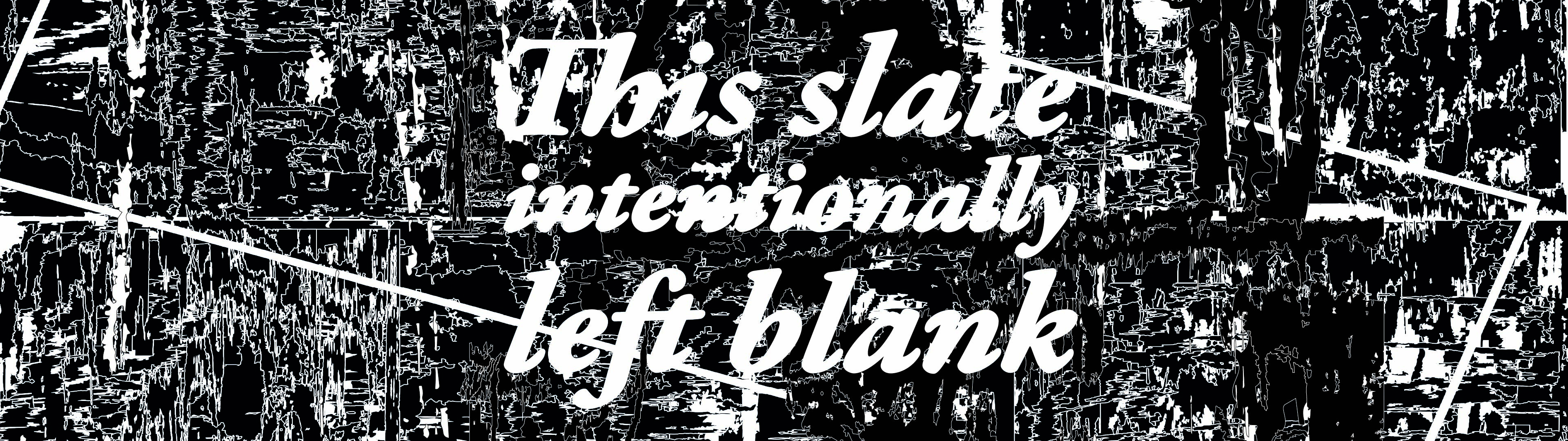
It all starts with a slate. A blank slate. Upon admission to the academy, each member is assigned one—and only one—possession: a blank, rectangular piece of wood that they normally use as a worktable. Freshly cut, the tables are brought into the art classrooms, ready to serve as tabula rasa—clean surfaces for particular art media, be they painting, sculpture, or photography…
Despite the table borders between art classes, such tabula rasa-ism, such tabular racism, is never successful. On the worktables, there is always a mess, but it is a good mess—the mess of work-in-progress, the mess of media mixed together. All the walls and rooms at AdBK are mood boards for the works and their palettes. They are states of constantly mixed slates.
But inside the academy, there is one slate of space that is always intentionally left blank—the historic space of the Aula. The room is deeply attuned to the legacy of its 18th century French tapestries, which freeze things in place to preserve them as they are. Based on motifs from Raphael’s frescoes in the Vatican and permanently installed here, the tapestries regulate visiting and exhibiting: nothing can be hung on the walls, nor can images be projected onto them. The only way to overcome these obstacles is to hide the textures of the Aula in darkness so that new exhibition spaces can emerge.
This time, instead of hiding the inners of the Aula, the members of the Emergent Digital Media (EDM) class intentionally left it in all its naked blankness. The space is constantly lit and barricaded by a mix of table-slates, which provide what the Aula lacks: a slate to project onto, a slate to hang things on, a slate to build from. Surrounded by a multiplicity of the academy’s tables—in all their infinitely diverse mixture—the Aula surrenders its last line of defense, which has upheld the fascism of the clean medium.
For This slate intentionally left blank, the EDM class collected 101 tables from most of the classes at AdBK. The tables are folded into different shapes to form backrooms—spaces nested inside spaces (inside spaces), where media installations, screens, and sculptures wait to be found. The wallpaper-like texts—each starting with This slate…—lead visitors through the Aula to the works. The works broadly deal with the condition of ‘the digital’: the specific aesthetic and social relations produced under the conditions of synthetic data, generative AI practices and simulated three-dimensional space.
With works by
Tim Abels, Andre Bagh, Sofian Biazzi, Kristina Cyan, Torsten Hink, Jens Isensee, Millie Johnson and Antonio Dimovski, Hanne Kaunicnik, Petr Klíma, Benjamin Laabmayr, Angelika Lepper, Jiayi Li, Naho Matsuda, Lisa Meinig, Guillaume Menguy, Otto Raúl Ostermann, Sandro Prodanovic, Nikita Sazonov, Mira Schienagel, Zhengke Sun, Vasilii Vikhliaev, Mara Yakuba
Teaching: Prof. Hito Steyerl / Dr. Francis Hunger
Special thanks to the classes that lend us their slates and stands: Klasse Bibby, Nicolai, Kretschmann, Linke, Rosefeldt, Pumhösl, Kuri, Antunes, Rogg. Thanks to the AdBK staff and the workshops. Thanks to Volker Möllenhoff, Iska Jehl, Martin Bohsung, Birgit Wagner, Moritz Walser, Ulrich Gebert. And thanks to our classmates that could not be here with us: Julia Koch and Huan Fu.
Graphic Design : Lars Oschmann
Concept, Texts : Nikita Sazonov
Editorial : Angelika Lepper
Production, Spatial Concept : Otto Raúl Ostermann, Hanne Kaunicnik, Guillaume Menguy
Production : Lisa Meinig
A collective effort by the EDM Class