
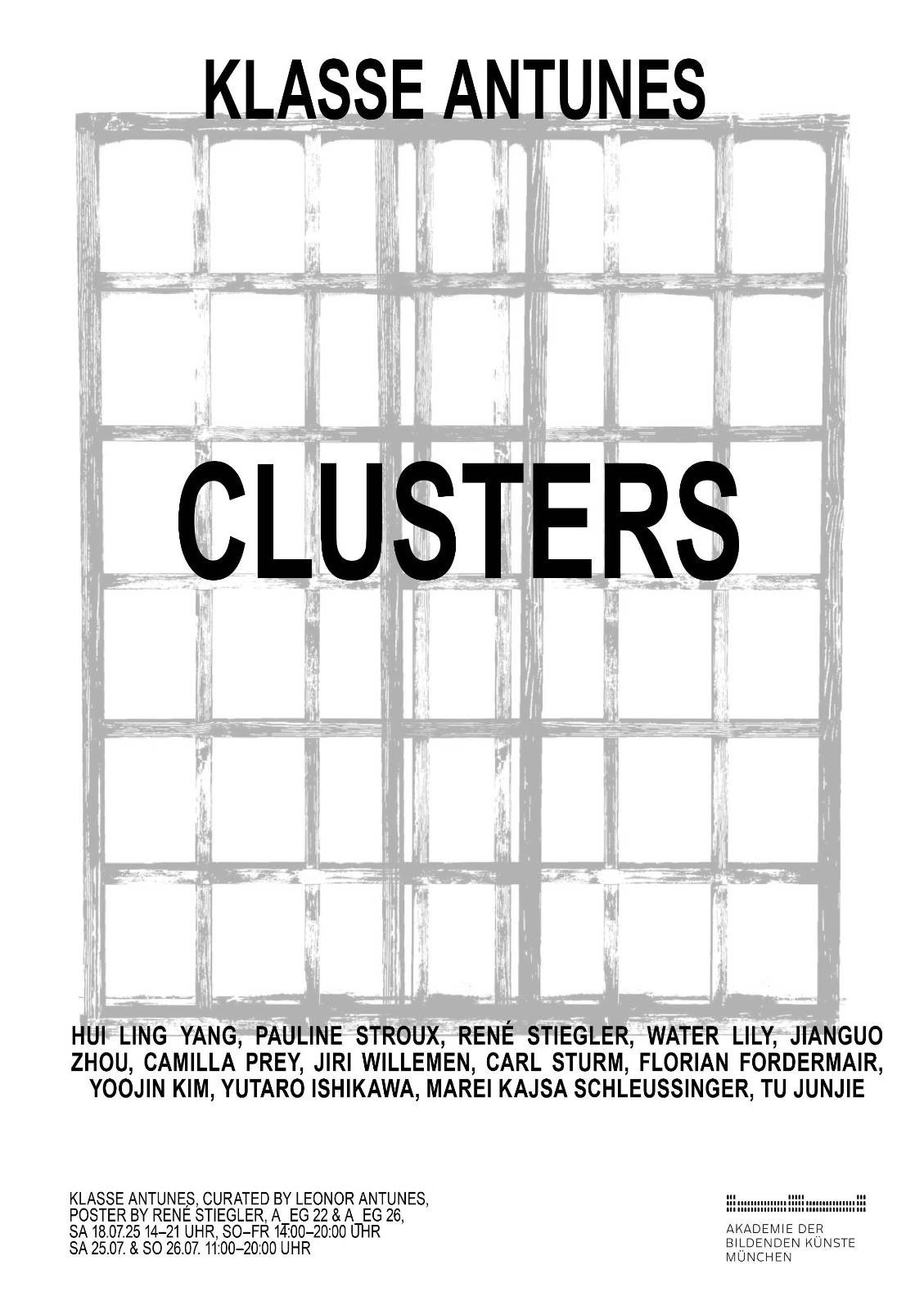
Klasse Antunes
在藝術家二人組的電影《我將在四十天后回家》(1997)中
Rijke/de Rooij - 一部 15 分鐘、近乎抽象的 16 毫米冰山電影,
部分改編自皮爾保羅帕索里尼的《Il fiore delle mille euna notte》
(《一千零一夜之花》,1974),又名《阿拉伯之花》
受《夜》的啟發,我們將以冥想式的繞行來引導我們。
迪斯科灣偏遠小鎮附近有一座孤零零的冰山
格陵蘭島西部的伊盧利薩特深深吸引了觀眾。影片由此展開。
緩慢而穩定地進行,以便能夠拍攝下來。
藝術家們每天早上都會往船上裝冰塊。
我在AdBK擔任教授的任期正好是三個月前開始的。
Zwischen dem Brechen des Eises und dem Lernen, wie man gemeinsam und
individuell in einem Raum koexistiert, der von Anwesenheiten und
Abwesenheiten geprägt ist, spielt sich der Epilog dieser Ausstellung ab.
Diese Jahresausstellung ist eine Feier, ein Moment, der diese zeitlosen
Bemühungen einfängt und das Bedürfnis greifbar macht, innerhalb einer
Gemeinschaft zu existieren und gleichzeitig eine eigene Stimme zu haben.
Die Ausstellung erstreckt sich über die beiden Klassenräume A_EG_22 und
A_EG_26. Beide Räume werden als eine Einheit genutzt und fungieren als
Spiegelbilder, in denen sich Kopien mit unheimlicher Beharrlichkeit durch die
Räume ziehen. Wie im Fall von Florian Fordermairs „leaking life“, wo sich
Pyrolysierte Baumstämme vermehren und die Ecken von beiden Räumen
bevölkern oder bei Pauline Strouxs „Maybe it´s // wrong to look for a
human body“. Die beiden Werke wurden speziell für die Klassenräume
geschaffen und wirken wie Körper: irgendwie ist das, was verborgen bleibt,
zugleich auch das, was offenbart wird. Oder wie bei Jianguo Zhous, dessen
Performance „Absent Logos“ den gesamten Raum einnimmt, indem er mit
einem handgefertigten Pinsel, in den Wasser gepumpt wird, direkt auf den
Boden malt. Dieselbe performative Geste wird in einer anderen Landschaft
durchgeführt und als Video an die Wand des gespiegelten Raumes projiziert.
Diese Präsentation sollte sowohl als im Entstehen begriffen als auch als ineinem vorübergehenden Zustand befindlich verstanden werden - damit
meine ich ihren materiellen Charakter sowie ihren vergänglichen und
flüchtigen Status. Einige Werke werden vorübergehend aktiviert und neu
arrangiert, wie beispielsweise bei Camilla Preys „1“. Ein Metallrohr ist parallel
zum Boden aufgehängt, an dessen beiden Seiten Kerzen befestigt sind.
Sobald es von der Künstlerin durch Drehen aktiviert wird, tropft das
geschmolzene Wachs auf die Papiere auf dem Boden und hält so seine
Bewegung fest. Oder wie in Yutaro Ishikawas „Untitled“: zwei Holztafeln, die
der Künstler in Anlehnung an Shoji (eine traditionelle japanische Tür mit
Holzgitterrahmen) angefertigt hat, werden vom Künstler mithilfe von
elektrifizierten Metallpedalen aktiviert, die als instrumentales Gerät
fungieren. Oder in Yoojin Kims „The Revived Oboe“: Die Künstlerin fertigte
eine Nachbildung ihrer eigenen Oboe aus Glas an; das im Raum stehende
Glasobjekt ist über einen Silikonschlauch mit einer kompakten
Nebelmaschine verbunden, ebenso wie in Carl Sturms „Midnight Diner“ – eine
tragbare Küche, die genau in das vorhandene Fahrrad passt.
Oder „Ā mā“ von Hui Ling Yang: die Künstlerin fertigte zwei Tischbeine aus
Holz an, die dieselbe Form und Größe wie der Tisch ihrer Großmutter haben
und mit mehreren Schichten organischer Abfälle bedeckt sind. Jiri Willemens
„I saw a deer, but it was made out of plastic“ – zwei umgestaltete Modelle
von Jagdtürmen; Marei Kajsa Schleussingers „magicalmysteryworkplace“ –
wo ein gefundener Schminktisch in einer neuen Konfiguration zum Einsatz
kommt; Tu Junjies „Monica“, bei der gefundene Plastikhandschuhe
zusammengenäht wurden, sodass sie einer Porzellanvase ähneln oder in
René Stieglers Werk „Torn like the seams of my favourite jeans“ – ein eher
kleines, hybrides und vieldeutiges Objekt, das auf Augenhöhe der
Betrachtenden an der Wand angebracht ist. Und schließlich in „Water Lilys,
Untitled“ – zwei aus einem einzigen Stamm geschnitzte Holzarme, die uns
die bisweilen machtlosen Formen der Kommunikation vor Augen führen.
English Version:
In the film Im Coming Home in Forty Days, (1997) by the duo of artists
Rijke/de Rooij, a 16mm, 15-minute film near-abstract circumnavigation of
an iceberg in Greenland, partly inspired by Pier Paolo Pasolinis Il fiore delle
mille e una notte (The Flower of the 1,001 Nights, 1974), aka Arabian
Nights, we are caught by a meditative circumnavigation of a single iceberg
in Disko Bay, near the remote town of Ilulissat in western Greenland. The
travelling of the film is slow, and steady, so in order for the work to be
filmed the artists loaded the boat with blocks of ice each morning.
My arrival at the AdbK, as a professor in this class, began exactly three
months ago. Between breaking the ice, and learning how to coexist
together and individually, in a space loaded by presences and absences, is
where the epilogue of this exhibition takes place.
This final year exhibition acts as a celebration, a moment that catches and
materialises such timeless efforts, the need to co exist within and as an
individual voice.
The exhibition is spread between the two classrooms, A_EG_22 and
A_EG_26. Both spaces are used as one single unit, acting as tropes of
mirroring, where copying can occur with uncanny insistence throughout the
rooms, as in the case of Florian Fordermairs leaking life, where pyrolyzed
trunks proliferate and populate the corners of both rooms, and Pauline
Stroux: Maybe its // wrong to look for a human body - this two works were
made specifically for the two rooms, acting like bodies, somehow what its
hidden is also what is revealed. Or Jianguo Zhou: Absent Logos - whose
performance takes over the scale of the room by drawing directly on the
floor, using a hand made brush, where water is pumped into. This same
performative gesture is captured in a video in a different landscape and
projected on the wall in the other room.
This presentation should be read as in process as well as in a transient
state, by this I mean, its materials, and impermanent and ephemeral status.
Some works are being temporarily activated and rearranged, as in Camilla
Prey, 1- one metal tube is hanged parallel to the floor, with candles sticked
in each side, once activated by the artist by rotation, the melted wax is
dropped onto the papers on the floor registering its movement,
or as inYutaro Ishikawas Untitled- two wooden panels the artist made thinking of
Shoji, (wooden lattice framed traditional Japanese door) are being activated
by the artist with the use of metal electrified pedals, acting as an
instrumental device. Or in Yoojin Kims The Revived Oboe, the artist made a
replica of her own Obe in glass, standing in the room the glass piece is
connected to a compact fog machine via a silicone tube, as well as in Carl
Sturm: midnight diner- a portable kitchen is made to fit precisely in an
existing bicycle.
Or, Ā mā by Hui Ling Yang, the artist made two wooden table legs that have
the same shape and size as her grandmas table, are covered by several
layers of organic waste; Jiri Willemens I saw a deer, but it was made of
plastic- two reconfigured models of hunting towers; Marei Kajsa
Schleussingers magicalmysteryworkplace- where a found vanity desk is
occupied in a new configuration; Tu Junjies Monica, where found plastic
gloves, are sewn together giving similarity to a porcelain vase, or in René
Stieglers - Torn like the seams of my favourite jeans - a rather small hybrid
and ambiguous object is placed on the wall at the artists eye level. And
finally in Water Lilys , Untitled - two wooden harms sculpted from one single
trunk, reveal to us the sometimes powerless uses of communication.
Leonor Antunes
With
Hui Ling Yang
Pauline Stroux
René Stiegler
Water Lily
Jianguo Zhou
Camilla Prey
Jiri Willemen
Carl Sturm
Florian Fordermair
Yoojin Kim
Yutaro Ishikawa
Marei Kajsa Schleussinger